Monday, August 31, 2015

Wayne Dyer’s Advice on Retirement

When I think back over the life and work of Wayne Dyer, for some reason what I remember first is his advice on retirement. Perhaps it is because it was one of his farthest forays into my chosen field of economics. Retirement, Dyer insisted, was not something to aspire to, but a fraud that you were better off not participating in. It was a concept that powerful commercial interests would try to enroll you in, but your own interests lay elsewhere. At the risk of trying to quote from memory, he said something rather like, “Take the word ‘retirement’ out of your vocabulary.”

I was skeptical, but in the end, I became convinced that he was right. Mortality and disease statistics back up what he was saying. So many people die the year after they retire that it would seem you will live a happier life if you find a way to keep working in your old age regardless of what the institutional forces around you say you should be doing. If you are forced out of one job because of your age, you can take another. If no employer will have you, you can arrange for work on your own terms. Statistically speaking, that is the most reliable way to stay healthy and happy. But if the best strategy is to maintain and protect your ability to work for as long as you can, then what is the use of retirement?

Dyer himself never quite retired, though he lived to be 75. In his recent interviews, his message and advice continued to evolve as it always had. His web site lists 11 upcoming events, appointments he won’t be keeping. The last listed is a conference near me in September 2016, a keynote address that I surely would have attended. When I reflect on this, I ask myself, why wouldn’t you want to live your life such that your death represents not merely an occasion of sorrow but an actual, practical loss to the people around you? I think this is something to aspire to, rather than the commercial idea of an endless vacation. It you are inspiring people, solving problems, doing some kind of useful work that not just anyone can do, then after your departure, you will be missed in more ways than one.

Friday, August 28, 2015

This Week in Bank Failures

Workers at HSBC in the U.K. were working late tonight to fix a failed payments system that had dropped an estimated 275,000 payments. Most of the payments were direct deposits of paychecks, so it was a high-profile gaffe from a bank that has faced more than its share of problems this year.

The U.S. Department of Labor has tentatively declined to recommend waivers for three giant banks that manipulated base rates, and in one case, also manipulated stock prices. Without the waivers, the banks will have to stop managing retirement accounts.

Bad loans are starting to pile up in China, according to the latest reports from the largest banks there. Construction companies have long been credit risks in China, but factories and retailers are starting to miss payments too as the manufacturing sector slows.

Bloomberg reported on a fake Goldman Sachs in China. A leasing company using the Goldman Sachs name, but not connected to the real Goldman Sachs, is said to have links to organized crime.

A credit union was liquidated today. State regulators in Iowa put SCICAP Credit Union, with around 1,000 members, into receivership. The NCUA then transferred most assets and member accounts to Community 1st Credit Union.

Lower Fuel Prices, More Driving Miles

With U.S. fuel prices down by 1/3 since last year, you would guess that people were driving more, and we are, but not a lot more. Total vehicle miles as estimated by the U.S. Department of Transportation are up about 4 percent from the year before. That is enough to set an all-time record for the country, as population growth adds to the slight increase in individual driving.

The increase of 4 percent is barely enough to create an increase in the total amount of motor fuel sold. The countertrend of increasing fuel efficiency, which includes electric, natural gas, and hydrogen vehicles is probably enough to cancel out the increased driving distance in the long run. The replacement cycle for vehicles is also part of the fuel efficiency trend. When vehicles from the 1990s are retired and replaced with new vehicles based on current designs, fuel efficiency goes up. Of course, if the quantity of fuel is about the same, that means the revenue from fuel has declined by about a third from last year.

Thursday, August 27, 2015

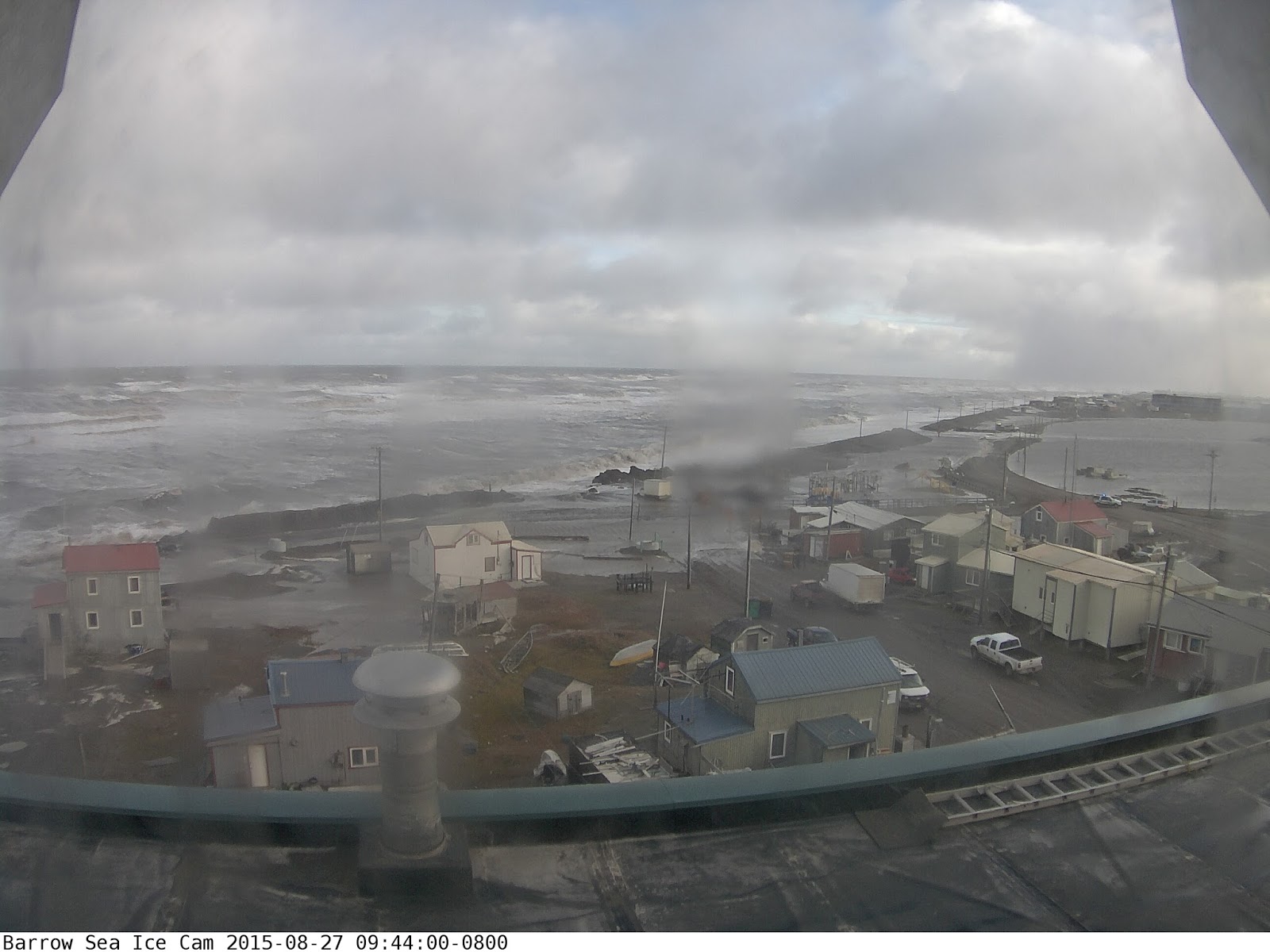
Climate Change Hits Barrow

A webcam at Barrow, Alaska shows coastal flooding from a moderate storm in the Arctic Ocean to the north. It is not a severe storm by Atlantic or Pacific standards, but Barrow was built on low-lying land. When Barrow was built no one expected the town would see the effects of summer storms because the sea ice that previously covered the Arctic Ocean would dampen any storm effects. In the last 20 years similar storms have threatened villages on the west coast of Alaska. Now with retreating sea ice, this effect has reached the north coast.

As sea ice retreats in future years and the sea waters warm, this kind of storm at Barrow will be a routine occurrence. It is easy to see that some buildings will need to be reinforced against the waves. In the long run, with a sea level rise of 7 meters on the way within 200 years or less, the entire town will eventually have to move to higher ground.

Update: In Alaska Dispatch News: High winds cause flooding in Barrow, prompts Shell to pause oil drilling

Wednesday, August 26, 2015

The Boston Olympics and the Downward Spiral

Imagine if Boston had taken on the Olympics, and imagine if revenue shortfalls and cost overruns had totaled $3 billion. Boston is a large city, but not that large. Taxpayers would be on the hook for $4,550 per person. Not everyone pays taxes, so the average per taxpayer would be higher. It is extremely difficult to make up that kind of shortfall through taxes. A special one-time tax on that scale would drive a significant fraction of taxpayers into bankruptcy, ruining the city economy and reducing future tax revenues. An increase in tax rates over an extended period of time would drive residents and would-be residents beyond the city limits, again reducing tax revenues. Boston would be stuck in a bind, most likely struggling for half a lifetime to keep up with its bills, much like Detroit, Harrisburg, or Puerto Rico. Each place is in a downward spiral created by government debt and taxes. Tax rates are high enough to drive taxpayers away, so that the growth that could solve the governmental fiscal problems can never arrive.

But wait. The likely cost overruns for hosting the Olympics would be much higher than $3 billion. The deficit could easily be $10 or even $20 billion. The Olympics are always more expensive than early estimates suggest, as Andrew Zimbalist notes in Harvard Magazine:

The risks are formidable, and London’s experience in 2012 is instructive. London earned $3.5 billion directly from the Games, yet spent more than $18 billion before factoring in infrastructure investments. Further, tourists stayed away . . .

London’s total Olympics deficit, then, was around $16 billion. But London is a very large city. It can arguably spend that kind of money. A $16 billion deficit in the Boston Olympics would have been made up by the taxpayers at a cost of $25,000 per person. That would have been a tax bill high enough to ruin the city for the next 50 years.

It’s no accident that Boston officials cited this very risk when they elected not to sign the papers for the Olympics. It is a little scary that they came as close as they did to going forward. We have a small group of determined activists to thank for averting this calamity.